My Work

What I do
I visualize and analyzes the EPA’s National Walkability Index across U.S. census block groups, helping planners, advocates, and communities understand and compare neighborhood walkability through maps, data tools, and urban insights.
Municipalities & MSAs
At the metropolitan scale, the American Walkability Atlas analyzes patterns across entire urban regions using the EPA’s National Walkability Index. By aggregating Census block group data, it identifies how intersection density, transit access, and land-use diversity vary across metropolitan areas, highlighting regional trends in connectivity, accessibility, and development form.
I will continue adding to this section.
City Neighborhoods
As of right now I have interactive maps for the following cities:
- Arlington, TX
- Boston, MA
- Cambridge, MA
- Chicago, IL
- Cleveland, OH
- Columbus, OH
- Dallas, TX
- Denver, CO
- Detroit, MI
- Houston, TX
- Indianapolis, IN
- Los Angeles, CA
- Minneapolis, MN
- New York City, NY
- Pasadena, CA
- Philadelphia, PA
- Phoenix, AZ
- Pittsburgh, PA
- Saint Paul, MN
- San Diego, CA
- San Francisco, CA
I will continue adding to this section. If there is a specific city you would like to see analyzed at the neighborhood level, please contact me via email.
I will continue to acquire neighborhood-level shapefiles for additional cities. The following datasets are still in progress and are expected to be completed by early March:
- Alameda, CA
- Anaheim, CA
- Berkeley, CA
- Bridgeport, CT
- Charleston, WV
- Dedham, MA
- Fresno, CA
- Gary, IN
- Irving, TX
- Memphis, TN
- New Haven, CT
- Salt Lake City, UT
- San Angelo, TX
- Santa Monica, CA
- Waco, TX
Methodology of Research
About the Walkability Index
The American Walkability Atlas builds upon research initially developed during my master’s degree program. Central to this project is the U.S. Environmental Protection Agency’s National Walkability Index (NWI), a nationwide framework that evaluates walkability at the Census block group level. The NWI assesses how supportive the built environment is of walking by examining three core dimensions:
- Design: The connectivity of the street network, measured through intersection density.
- Distance: Residential proximity to public transit stops.
- Diversity: The degree to which employment, services, and housing are co-located within a given area.
Collectively, these dimensions capture key built environment characteristics shown to influence walking behavior.
How the Index Works
Each Census block group is assigned a walkability score ranging from 1 to 20, with higher values indicating greater walkability. These scores are derived from four standardized indicators:
- Intersection density: Higher concentrations of street intersections provide more direct and varied walking routes.
- Proximity to transit: Shorter distances to transit stops increase the likelihood of walking as part of daily travel.
- Employment mix: A diverse range of nearby employment opportunities supports walking for work-related trips.
- Employment–household mix: A balanced distribution of jobs and housing fosters environments where walking is integrated into everyday activities.
Block group scores are subsequently grouped into categorical classes ranging from Least Walkable to Most Walkable.
Walkability Classification
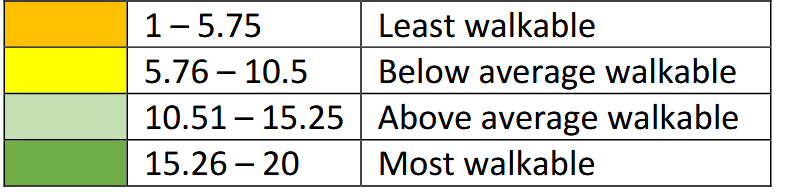
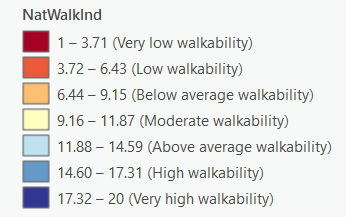
In my professional report, walkability scores were categorized using the EPA’s standard four-class system. For the American Walkability Atlas, this classification was expanded to a seven-class system to provide greater spatial nuance and interpretive clarity. Rather than broad distinctions such as “low” or “high,” the expanded framework differentiates between categories such as very low, moderate, and very high walkability.
Below on the left, the original four-class legend follows conventions established by the EPA and prior academic studies (U.S. Environmental Protection Agency, 2021; Watson et al., 2020).
While on the right the seven-class legend represents an original adaptation developed for this project.
Walkability Analysis Methodology
All spatial analysis and mapping were conducted using ArcGIS Pro, drawing directly from EPA-provided block group data. Analytical procedures replicate the EPA’s methodology to ensure consistency and comparability with the National Walkability Index.
Walkability is examined across multiple spatial scales, including:
- Metropolitan and municipal levels
- Neighborhood-level geographies, such as Venice in Los Angeles and comparable districts in other U.S. cities
Geographic Scope and Boundary Selection
To achieve nationwide coverage, municipal boundary datasets from all U.S. states were merged into a single national layer. The primary focus is on cities with populations of at least 5,000 residents, with selective inclusion of smaller cities down to 2,500 residents where appropriate. These thresholds align with U.S. Census Bureau definitions of urban areas.
For each municipality or neighborhood, Census block groups are selected based on whether their geographic centroids fall within the defined boundary. This approach ensures that walkability scores are spatially aligned with the areas where people live, work, and travel.
Spatial Aggregation and Scale Effects in Municipal Walkability Scores
Before discussing the weaknesses and limitations of this research, it is important to clarify how walkability scores are calculated at the municipal level. For each municipality, the reported National Walkability Index score and the associated four component variables represent the average of all census block groups whose centroids fall within the city’s boundaries.
Using the City of Dallas as an illustrative example, more than 900 census block groups have centroids located within the municipal boundary. Consequently, the walkability score reported for Dallas reflects an aggregate average across these 900 block groups rather than conditions at any single location.
Given the geographic size and internal heterogeneity of many cities, municipal-level averages can obscure substantial variation in walkability. For this reason, the analysis also examines walkability at finer spatial scales, including neighborhood and district levels. For example, Downtown Dallas—defined here as the area bounded by I-30, I-345, I-35E, and Spur 366—consists of only seven census block groups, allowing for a more nuanced and localized assessment of walkability conditions.
Challenges, Limitations, and Purpose of Research
Challenges of Website Building and Graphics Visualization
Development of what would become the American Walkability Atlas began in early August 2025. At the outset, I had no prior experience in website development and therefore relied on online tutorials and a process of trial and error to acquire the necessary skills. After evaluating several hosting platforms, Hostinger was selected, and the website was developed using Elementor as the primary design tool.
Once the website was operational, I began uploading static PDF map outputs generated in ArcGIS Pro. At this stage, several limitations became apparent. PDF maps can display only a limited number of layers and labels effectively, and the volume of content required for the project was substantial. Specifically, the website required five maps per Metropolitan Statistical Area (the National Walkability Index and four component variables: intersection density, proximity to transit, employment mix, and employment–household mix), as well as an additional five maps for each city analyzed at the neighborhood level. Presenting this volume of static maps would have resulted in an unwieldy and visually overwhelming user experience.
To address this challenge, the ArcGIS Pro projects were migrated to ESRI’s ArcGIS Online platform, allowing the maps to be presented in an interactive format. These interactive maps were then embedded into the website, enabling users to select individual municipalities or neighborhoods and view associated attribute information, including the National Walkability Index score and the scores for each of the four contributing variables.
However, the use of ArcGIS Online introduced another constraint: hosting large geospatial datasets requires paid credits and given the scale of the data used in this project, available credits were exhausted in less than one week. To resolve this issue, I transitioned the workflow to the open-source QGIS platform. All ArcGIS Pro projects were transferred to QGIS, and after becoming proficient with the software, I exported the interactive maps as standalone HTML files. Because these HTML files were initially private, they were first uploaded to GitHub to make them publicly accessible prior to embedding them on the website.
Further technical limitations arose during the GitHub hosting process. While neighborhood-level city files uploaded without issue, the municipality-level datasets posed significant challenges due to file size. Each set of five municipality maps (the National Walkability Index and four component variables) exceeded 100 MB, far surpassing GitHub’s 25 MB file size limit. An initial solution involved dividing the municipality maps by broad U.S. regions (Northeast, South, Midwest, and West); however, the South, Midwest, and West regions remained too large to host as single files. As a result, the data were further subdivided by Census divisions.
Consequently, the municipality-level section of the website is organized into six map groupings, structured as follows:
- New England & Mid-Atlantic (Northeast)
• South Atlantic & East South Central
• West South Central
• East North Central
• West North Central & Mountain
• Pacific
This organizational structure allowed the project to remain within hosting constraints while maintaining usability and ensuring that large-scale, municipality-level walkability data could be accessed efficiently.
Weaknesses/Limitations
It should be noted that the data presented in the American Walkability Atlas should not be interpreted as a definitive or comprehensive assessment of pedestrian conditions. While the National Walkability Index (NWI) is a valuable analytical tool, it has several important limitations that warrant consideration.
- Limited Representation of Pedestrian Infrastructure Quality
The National Walkability Index is derived primarily from land-use and built environment variables—specifically street intersection density, proximity to transit, and land-use diversity. As a result, it does not account for critical pedestrian infrastructure and design features observable at the street level, including:
- the presence and condition of sidewalks
- curb ramps and accessibility for people with disabilities
- shade, lighting, seating, and other amenities that influence pedestrian comfort and usability
Because these elements are excluded, areas may receive relatively high walkability scores despite offering substandard or uncomfortable walking environments (America Walks, n.d.; McGinn, 2025).
- Omission of Safety and Micro-Environmental Factors
The Index also omits direct measures of pedestrian safety and perceived security, such as:
- pedestrian crash data and traffic speeds
- safe crossing infrastructure (e.g., marked crosswalks, refuge islands)
- crime rates or perceptions of personal safety
Consequently, some areas may score highly due to favorable spatial configurations while remaining places where walking is unsafe or unattractive in practice (Pinski & McCarthy, 2023).
- Methodological Focus on Indicators, Not Actual Behavior
The Index is a proxy measure using built environment characteristics rather than direct measures of walking:
- It doesn’t measure how much people actually walk.
- It can overestimate walkability where environmental conditions discourage walking despite high accessibility (e.g., long, unsafe street crossings).
This means the NWI reflects potential walkability more than real human behavior (Steuteville, 2019).
- Doesn’t Include Non-Built Environment Influences
Critical influences on walkability such as:
- weather conditions
- topography (e.g., steep streets)
- social perceptions of walkability
- cultural or lifestyle patterns
are not captured, although they affect whether people choose to walk (Steuteville, 2019).
Illustrative Case: International Market Place, Indianapolis
The limitations described above are illustrated by the example of the International Market Place neighborhood in Indianapolis. The neighborhood boundary (shown in red) contains a single Census block group (shown in yellow) whose centroid falls within the neighborhood. This block group receives a National Walkability Index score of 16.83, with an intersection density score of 16, a proximity to transit score of 18, an employment mix score of 14, and an employment–household mix score of 19.
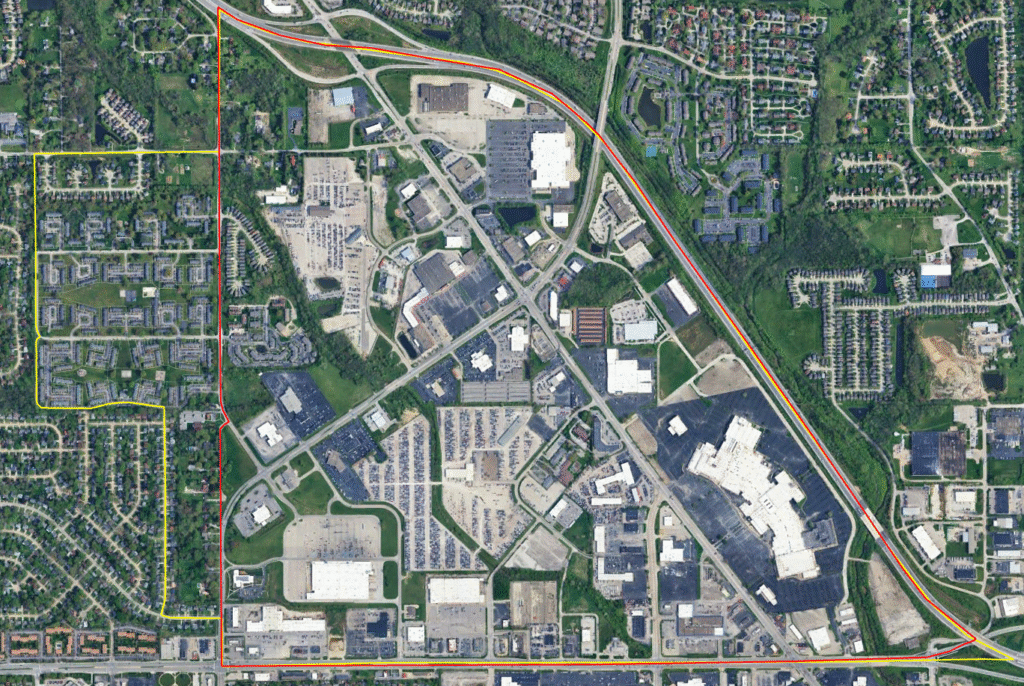
At face value, these values suggest a highly walkable environment. However, visual inspection of the area reveals conditions that are largely inhospitable to pedestrians. Consistent with many postwar development patterns, the street design prioritizes vehicular movement over pedestrian comfort—an approach succinctly characterized by Duany & Plater-Zyberk (1992) as designing places where “cars must be happy.”
Sidewalk coverage is sparse, and where sidewalks do exist, pedestrians are often constrained between high-speed traffic on one side and expansive surface parking lots on the other. In genuinely walkable environments, on-street parking frequently serves as both a physical and psychological buffer between pedestrians and moving vehicles—an element notably absent in this case.
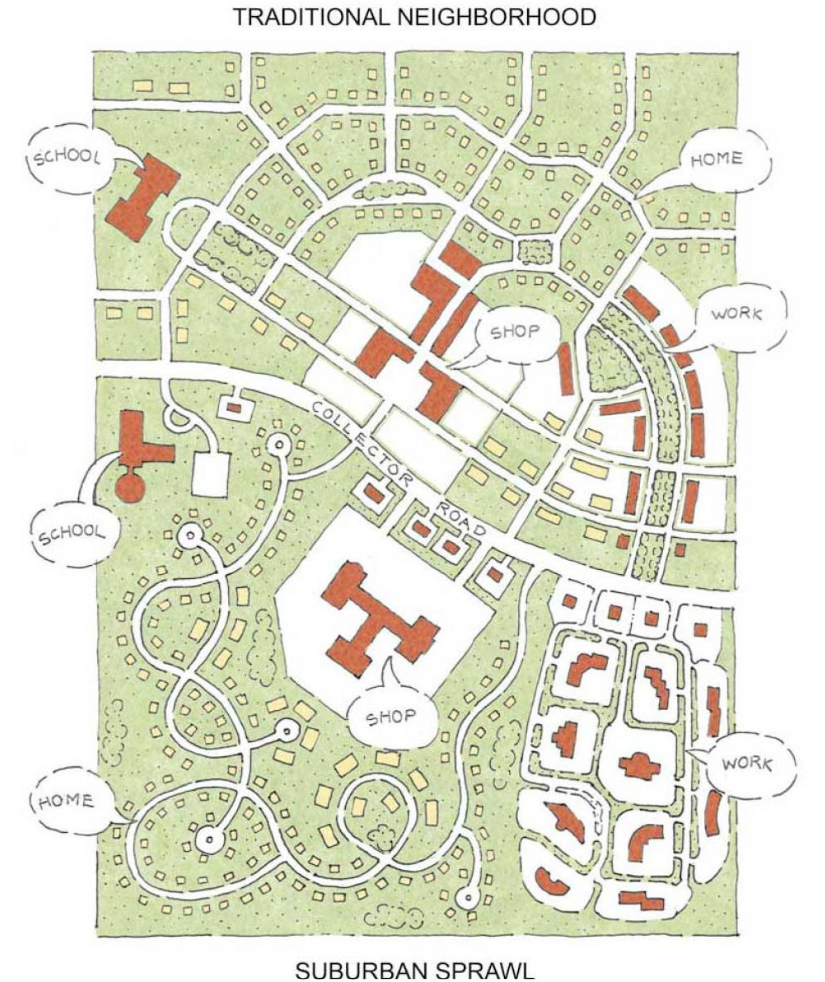
Additional barriers include the spatial separation of residential uses from nearby retail and industrial destinations. While walking between these uses may be theoretically possible, the lack of direct, comfortable, and safe pedestrian connections makes automobile travel the de facto mode of access. Despite its high NWI score, the International Market Place more closely resembles suburban commercial sprawl than a traditional, pedestrian-oriented neighborhood (Steuteville, 2016).
- Geographic Scale Issues (Census Block Groups)
The NWI is calculated at the census block group level, which can be quite large or heterogeneous. This introduces two problems:
- Local walkable pockets within a block group may be averaged with non-walkable areas, lowering the score.
- Conversely, areas with poor walking environments but nearby amenities can score higher than actual conditions suggest.
This spatial aggregation can mask fine-grained variations that matter to pedestrians (Steuteville, 2019).
Another limitation of using Census block group–level data is that many municipalities—particularly very small or rural jurisdictions—are too small to contain a block group centroid. In some cases, multiple municipalities fall within a single block group, making it difficult to assign distinct and representative walkability scores to each jurisdiction.
Similar issues arise at the neighborhood scale. For example, users familiar with Columbus, Ohio, may notice that Wolfe Park is not included in the neighborhood-level interactive maps. Due to its very small geographic footprint, this neighborhood was excluded from the analysis. A comparable issue occurs in Dallas, Texas, where larger districts such as Northeast Dallas can be further subdivided into distinct neighborhoods, including Deep Ellum, Bryan Place, and Lower Greenville. Downtown Dallas presents a similar challenge, as it can be divided into eight subdistricts: the Arts District, City Center District, Convention Center District, Farmers Market District, Government District, Main Street District, Reunion District, and the West End Historic District.
At present, Fort Worth has not been analyzed at the neighborhood scale because many of its neighborhoods are too small to be meaningfully evaluated using block group–level data. While Census block–level data would offer greater spatial precision and potentially resolve some of these issues, it introduces additional methodological challenges due to the extremely small size of individual blocks. These challenges can replicate the same aggregation and interpretation issues observed with block groups in dense urban environments, which are discussed in the following section.
- Less Effective in Very Dense Urban Contexts
Some analysts note the Index may undervalue extremely dense, highly walkable cities because:
- Block groups in dense cities are geographically small and may lack sufficient land-use diversity within the block group itself (even though adjacent areas are highly walkable).
This can make scores less intuitive in downtown or urban core environments (America Walks, n.d.).
- Composite Nature Can Mask Key Variables
Because the Index combines different variables into a single score:
- One dominant component (e.g., transit proximity) can drive the score even if others (like intersection density) are weak.
- This makes it hard to interpret which specific elements most influence the score in any given place (Pinski & McCarthy, 2023).
As noted previously with the example of International Market Place in Indianapolis—where an area is classified as highly walkable despite offering poor pedestrian conditions—the opposite limitation can also occur. Some of the most genuinely walkable urban environments receive relatively low National Walkability Index (NWI) scores. This outcome reflects the Index’s reduced effectiveness in very dense urban contexts and the challenges associated with aggregating multiple variables into a single composite score. New York City provides a clear illustration of this limitation.
When evaluated alongside other U.S. municipalities, New York City exhibits a relatively low overall NWI score and is classified only as above average in walkability. This result is driven primarily by low intersection density values, particularly within Manhattan. At face value, this finding appears counterintuitive, as Manhattan is widely recognized as one of the most walkable urban environments in the United States.
The discrepancy arises from the extremely small size of many Census block groups in midtown and upper Manhattan. In numerous cases, these block groups encompass only a single city block and therefore contain no intersections within their boundaries. This pattern became evident during neighborhood-level analysis. While lower Manhattan appears less affected by this issue, the prevalence of small block groups elsewhere in the borough substantially suppresses intersection density scores and, by extension, the overall NWI score for the city.
Although employment mix and employment–household mix scores are also relatively low for New York City, a comprehensive assessment of these variables is still in progress. At the time of writing, analysis has been completed only for the boroughs of Staten Island and Manhattan. Further evaluation of the remaining boroughs is expected to provide greater insight into the factors influencing these components of the Index.
- Irregular Data Updates / Data Currency
The publicly released NWI is based on datasets from around 2017–2020, meaning:
- scores may lag behind current land-use or infrastructure changes.
- trends (e.g., new mixed-use developments or new transit service) may not be reflected until a future update (America Walks, n.d.).
Purpose of my Research
This research employs the EPA’s National Walkability Index as an exploratory analytical framework to visualize and compare broad spatial patterns of walkability across the United States. Although the Index has well-documented limitations—particularly at finer geographic scales—it remains a valuable tool for identifying where walkability-supportive land use structures are present and where structural gaps may exist within and across regions.
The interactive maps presented on this website are not intended to serve as direct policy instruments. Rather, they are designed to generalize spatial patterns, surface inconsistencies and anomalies in walkability classification, and prompt deeper, place-specific investigation. By allowing users to explore walkability comparatively and spatially, the maps function as a diagnostic and hypothesis-generating tool rather than a prescriptive measure.
By explicitly acknowledging both the strengths and limitations of the National Walkability Index, this work establishes a foundation for future research at finer spatial resolutions. Subsequent analysis will focus on intersection-level and network-based accessibility modeling using ArcGIS Pro, including service area and connectivity analysis aligned with concepts such as 5-, 10-, and 15-minute cities. From a longer-term policy perspective, this component of the website aims to encourage cities, planners, and private-sector actors to rethink the design of pedestrian environments in populated areas, with particular emphasis on mixed-use development, improved connectivity, and public transit integration.
Sources
America Walks. (n.d.). Walkable Land Use. America Walks Resources. https://americawalks.org/resources/walkable-land-use/?
Duany, A., & Plater-Zyberk, E. (1992). The Second Coming of the American Small Town. The Wilson Quarterly, 16(1), 19–50.
McGinn, M. (2025, September 18). How Many Americans Live in Walkable Neighborhoods? Streetsblog USA. https://usa.streetsblog.org/2025/09/18/how-many-americans-live-in-walkable-neighborhoods
Pinski, M., & McCarthy, L. N. (2023, April 12). Opinion: Surprised by Your Neighborhood’s Walkability Score? Don’t Be. Planetizen. https://www.planetizen.com/features/122592-opinion-surprised-your-neighborhoods-walkability-score-dont-be
Steuteville, R. (2016, September 30). Comparing Neighborhood and Sprawl. Public Square (Congress for the New Urbanism). https://www.cnu.org/publicsquare/2016/09/30/comparing-neighborhood-and-sprawl
Steuteville, R. (2019, January 10). Walkability Indexes Are Flawed—Let’s Find Better Methods. Public Square (Congress for the New Urbanism). https://www.cnu.org/publicsquare/2019/01/10/walkability-indexes-are-flawed-lets-find-better-method1
U.S. Environmental Protection Agency. (2021). National Walkability Index: Methodology and User Guide. U.S. Environmental Protection Agency (EPA). https://www.epa.gov/smartgrowth/smart-location-mapping#walkability
Watson, K. B., Whitfield, G. P., Thomas, J. V., Berrigan, D., Fulton, J. E., & Carlson, S. A. (2020). Associations between the National Walkability Index and walking among US Adults—National Health Interview Survey, 2015. Preventive Medicine, 137, 106122. https://doi.org/10.1016/j.ypmed.2020.106122