Proximity to Transit (Distance to Transit)
- Meaning:
This measures how close a block group’s population and jobs are to public transit stops, such as bus or rail stations. - Purpose:
It assesses accessibility to transit options, a key factor in reducing car dependence and promoting walking as part of daily trips. - Interpretation:
- High proximity to transit: Most residents and workers are within a short walk (e.g., ¼ mile to a bus stop or ½ mile to rail).
- Low proximity to transit: Few or no transit stops nearby, making walking less practical for commuting or errands.
- Why it matters:
Walkable places tend to have dense, mixed-use development near transit stops, allowing people to combine walking and transit in their travel routines.
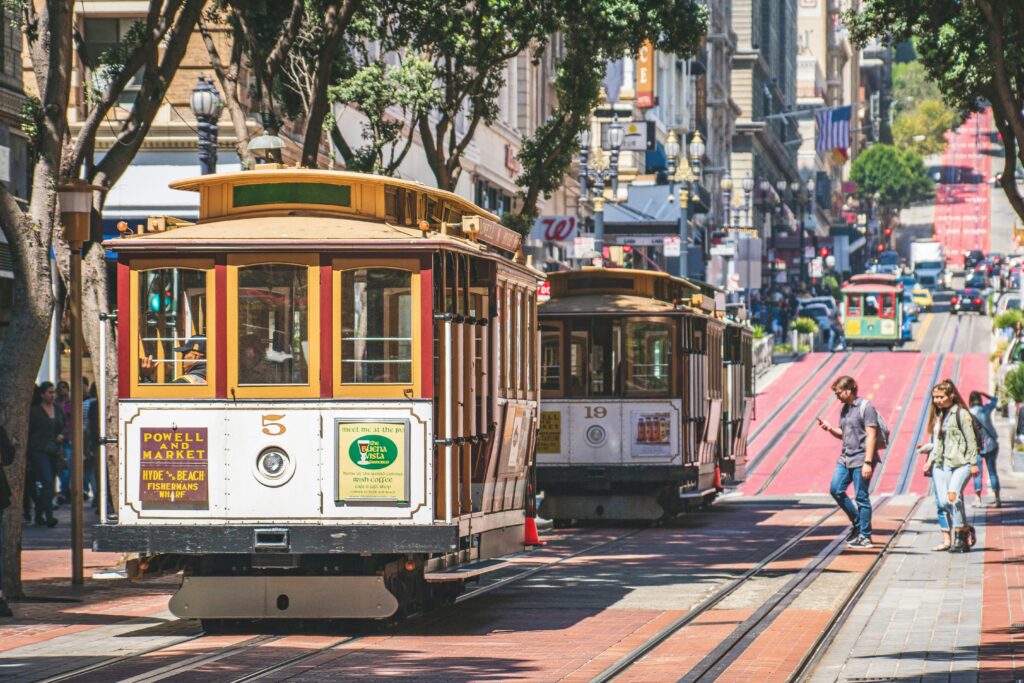
San Francisco Cable Cars right above
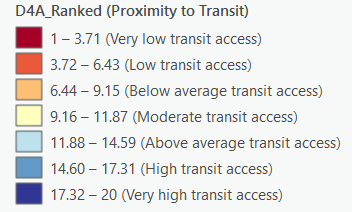
High Proximity to Transit
Characteristics
Very close to transit stops (typically within ¼ mile or less)
Often in areas with:
dense bus stop networks
light rail, subway, or commuter rail stations
multiple transit routes converging
Strong walkability and multimodal options
Examples
1. Manhattan (New York City, NY)
Subway stations spaced every few blocks
Dense bus network
One of the highest transit-accessibility areas in the U.S.
2. The Loop / River North, Chicago, IL
Chicago “L” stations nearby
Multiple bus routes overlapping
Frequent service throughout the day
3. Boston Back Bay / Downtown
Close to subway, commuter rail, and bus hubs
4. Portland, OR – Along MAX Light Rail
Dense network of light rail + streetcar + bus stops
These areas represent the upper end of D4A_Ranked due to extremely close and frequent fixed-route transit.
Moderate Proximity to Transit
Characteristics
Transit is available, but:
stops may be farther apart
service may be less frequent
local buses may be the primary mode
Typical in:
inner-ring suburbs
secondary urban nodes
towns with moderate bus networks
Examples
1. Charlotte, NC – Around Lynx Blue Line Stations
LRT stations spaced moderately apart
Good but not dense transit coverage compared to large cities
2. Silver Spring, MD (outside immediate Metro station area)
Walkable to bus routes, but farther from rail stops
3. Dallas Bishop Arts District
Streetcar stops nearby and bus service—but not as dense as downtown
4. Midtown Sacramento, CA
Decent bus and light rail access, but less station density than coastal metros
Moderate D4A_Ranked areas have reasonable—but not abundant—transit access.
Low Proximity to Transit
Characteristics
Few or no transit stops nearby
Long walking distances to nearest bus or rail stop
Very infrequent or nonexistent fixed-route service
Typical in:
low-density suburbs
rural areas
industrial zones
auto-oriented corridors
Examples
1. Suburban Frisco, TX
Limited fixed-route DART bus coverage
Most areas far from stops
2. Phoenix Far Suburbs (e.g., Surprise, Buckeye)
Bus routes sparse; no light rail in many neighborhoods
3. Orlando’s Outer Suburbs
SunRail concentrated in limited corridors; bus service thin in suburban zones
4. Inland Empire Industrial Areas (Riverside/San Bernardino, CA)
Vast distances between jobs and transit stops
These locations show low D4A_Ranked values due to minimal transit access.