Employment Mix
Meaning:
Employment mix measures how balanced or diverse the types of jobs are within a given area — particularly the ratio between retail employment (like stores, restaurants, and services) and office or non-retail employment (like professional services, manufacturing, or institutions).
Purpose in Walkability:
- A higher employment mix means people can meet more of their daily needs (shopping, errands, services) close to where they work.
- Areas with mostly one type of employment (e.g., only offices or only retail) are less walkable because they lack functional diversity.
In other words:
Employment mix reflects the balance of work-related destinations, which affects whether an area supports walking for errands and services during or after work hours.
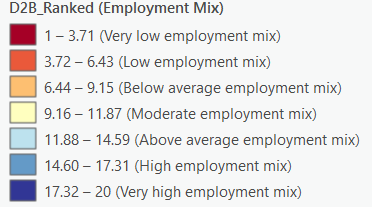
High Employment Mix
Characteristics
Balanced representation of multiple employment categories
Typically found in dense downtowns, mixed-use districts, and major commercial corridors
Workers and visitors come for many purposes: office, retail, restaurants, entertainment, healthcare, education
Examples
1. Midtown Manhattan, New York, NY
Heavy concentration of office towers, retail, dining, entertainment, hotels, & services.
Very high diversity of job types in small geographic areas.
2. Downtown Chicago (The Loop), Chicago, IL
Finance, government jobs, law offices, retail, restaurants, higher education, and cultural institutions.
Extremely high job diversity.
3. Downtown Portland, OR
Employment spans government, service, retail, office, education, and tech.
4. Uptown/Downtown Dallas, TX
Jobs in finance, law, technology, restaurants, medical centers, and retail — all within close range.
These locations score near the top end of the Employment Mix variable in the SLD.
Moderate Employment Mix
Characteristics
Some diversity of employment, but a couple of sectors dominate.
Often in suburban commercial arteries, university districts, or small downtowns.
Examples
1. Tempe, AZ – Near ASU
Education jobs + retail + food services + some office space create moderate employment balance.
2. Arlington, TX – Near UT Arlington & Downtown District
Mix of university jobs, local government, restaurants, small offices, and retail.
More varied than a single-sector job center, but not as diverse as a major downtown.
3. Walnut Creek, CA – Suburban Commercial Core
Retail + office + services, but fewer industrial or institutional jobs.
4. Midtown Memphis, TN
Medical district + local retail + small offices, producing a mid-level job mix.
Low Employment Mix
Characteristics
Dominated by a single employment category
Often located in:
Industrial parks
Warehousing/distribution districts
Retail shopping centers
Office parks
Very limited walkability because uses are separated.
Examples
1. Suburban Big-Box Retail Clusters (e.g., Katy Freeway, Houston, TX)
Mostly retail and food service; limited office or industrial employment.
2. Industrial Districts in Long Beach, CA
Port-related warehousing, shipping, and manufacturing dominate.
3. Silicon Valley Office Parks (Sunnyvale / Mountain View, CA)
Tech-heavy campuses with little retail or service employment in the immediate area.
4. Fort Worth Alliance Area, TX
Distribution and logistics jobs dominate, often producing very low employment mix.