“Ideally, every neighborhood should be designed with an even balance of residents and jobs. While this flies in the face of convention, it is not impossible to implement. All that is needed is for the housing and commercial developers to agree to work in the same location with a coordinated plan.”
-Andres Duany, Elizabeth Plater-Zyberk & Jeff Speck, Suburban Nation: The Rise of Sprawl and the Decline of the American Dream (10th Anniversary), 2010, p. 189
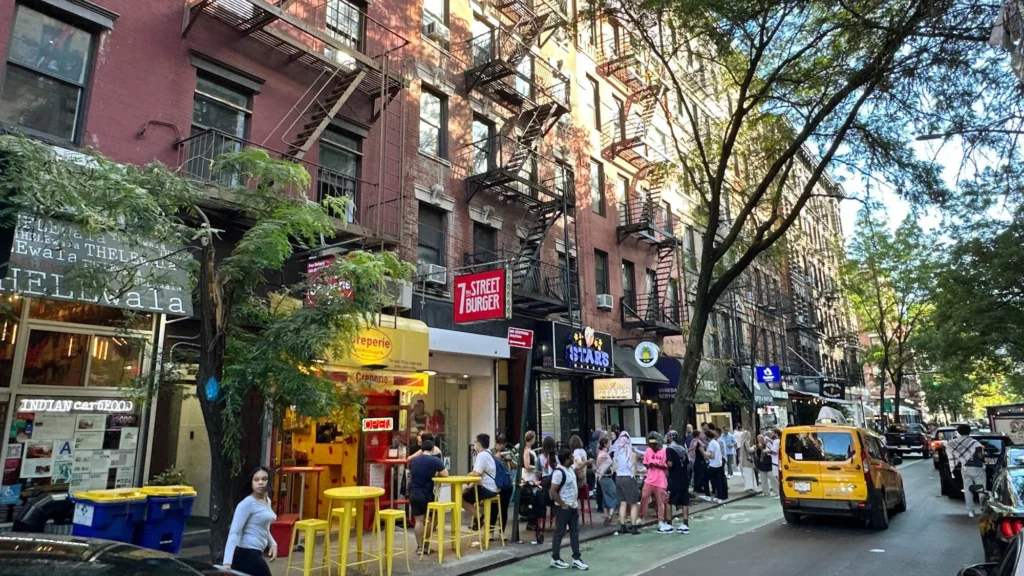
Greenwich Village, New York City. Photo from Tips for Visiting Greenwich Village, NYC
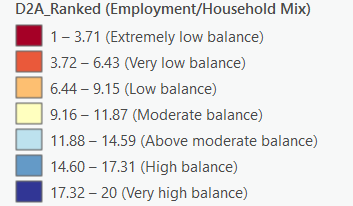
Employment and Household Mix (Jobs-Housing Balance)
Meaning:
This variable measures how closely employment opportunities and housing units are located within the same area — essentially, whether people can live near where they work.
Purpose in Walkability:
- A balanced employment and household mix reduces the need for long commutes and increases local activity, which supports walking and transit use.
- Areas that have only housing (suburbs) or only jobs (employment centers) tend to be less walkable.
In other words:
Employment and household mix represents the overall land use balance between jobs and homes, supporting walkable, mixed-use communities.
High Employment & Household Mix
Characteristics
Substantial residential population AND substantial employment located within close proximity
Often found in dense downtowns, mixed-use centers, transit-oriented developments
Strong walkability and activity throughout the day & evening
Examples
1. Lower Manhattan, New York, NY
High-rise residential towers mixed with financial, government, retail, and service jobs.
Strong jobs–housing balance, not purely a business district.
2. South Lake Union, Seattle, WA
Dense apartments + Amazon offices + retail, healthcare, restaurants.
One of the strongest job–housing mixes in the country.
3. Downtown San Diego, CA
Mixed mid-rise residential + government complex + convention center + retail.
4. Rosslyn–Courthouse Corridor, Arlington, VA
Heavy residential growth combined with high office density near Metro stations.
These areas score near the upper tier of D2A_Ranked.
Moderate Employment & Household Mix
Characteristics
Presence of both jobs and households, but one tends to dominate
Often found in:
university districts
older small downtowns
transitional neighborhoods
suburban town centers
Usually walkable but not fully balanced
Examples
1. Downtown Mesa, AZ (light rail corridor)
Government jobs + small offices + restaurants + apartments, but less intense than a major CBD.
2. Midtown Atlanta, GA
Strong mix but still heavier on residential than employment compared to Downtown.
3. Downtown Fort Worth, TX (outside the core towers)
Blend of housing units, offices, and entertainment, but with fewer residents per acre than top-tier downtowns.
4. University of Florida Area (Gainesville, FL)
Students + faculty + campus jobs + retail = balanced, but still campus-dominant.
Low Employment & Household Mix
Characteristics
Dominated by either:
residential-only areas, or
employment-only areas
Classic single-use zoning patterns
Weak walkability because daily needs are separated
Examples
1. Suburban Subdivisions (Frisco, TX or Gilbert, AZ)
Nearly 100% residential; few jobs within walking distance.
2. Industrial Employment Zones (e.g., Newark port area, NJ)
Warehouses and distribution centers; no residential presence.
3. Office Parks (e.g., Plano Legacy Business Park, TX – older sections)
Extremely job-heavy, minimal housing.
4. Big-Box Corridors (e.g., North Charleston, SC around Rivers Ave)
Retail employment with little or no residential density.
These locations exhibit low D2A_Ranked values and correspond to car-dependent environments.
References
Duany, A., Plater-Zyberk, E., & Speck, J. (2010). Suburban Nation: The Rise of Sprawl and the Decline of the American Dream (10th Anniversary). North Point Press.
O’Boyle, J. (November 3). Tips for Visiting Greenwich Village, NYC. The Empty Nest Explorers. https://www.theemptynestexplorers.com/blog/tips-for-visiting-greenwich-village-nyc