Metropolitan Intersection Density Across America
Explore how street intersection density varies across U.S. metropolitan statistical areas (MSAs). Higher intersection density generally creates more connected street networks, providing pedestrians with more direct routes, greater route choice, and improved access to destinations. The EPA includes intersection density as one of the four variables used to calculate the National Walkability Index because it is closely associated with pedestrian accessibility and transportation choice.
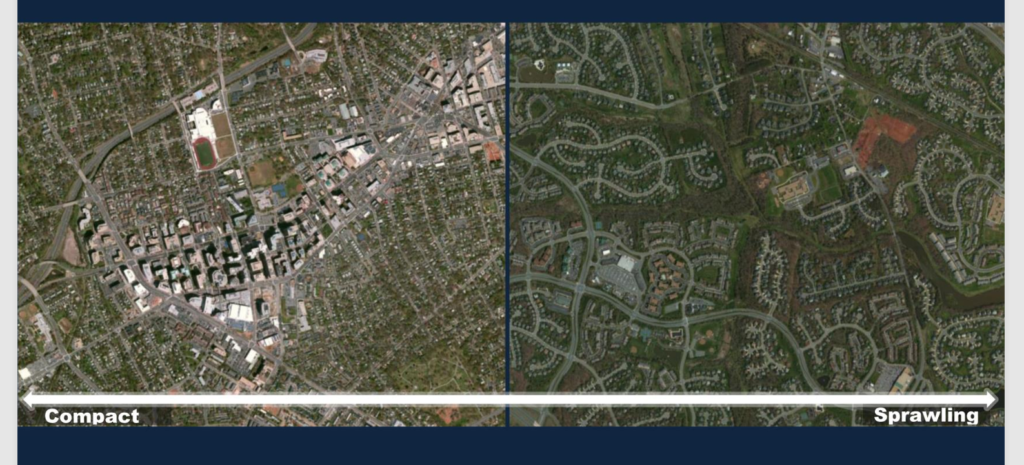
Comparison of a compact, interconnected street network (left) and a sprawling suburban street network (right). Compact neighborhoods generally exhibit higher intersection density, shorter block lengths, and greater route choice, while sprawling developments often contain fewer intersections, longer blocks, and more cul-de-sacs, resulting in lower street connectivity and reduced walkability. Photo from Ewing & Hamidi (2014).
Quick Statistics
94
Metropolitan Areas Analyzed
10.42
Average Intersection Density
1-20
Observed Density Range
Intersection Density (Design)
- Meaning:
Intersection density measures how many street intersections exist within a given area — typically the number of intersections per square mile. - Purpose:
It reflects how connected the street network is. Areas with more intersections (especially 3- or 4-way intersections) give pedestrians more route choices and shorter travel distances to reach destinations. - Interpretation:
- High intersection density: Grid-like street patterns, easy pedestrian navigation, shorter blocks (e.g., downtowns, traditional neighborhoods).
- Low intersection density: Cul-de-sacs, disconnected streets, car-oriented layouts (e.g., suburban developments).
- Why it matters:
Greater intersection density typically means better walkability, as it encourages walking, biking, and transit use by improving connectivity and safety through slower traffic speeds.
Neighborhood Type | Typical Intersection Density |
Historic downtown | Very High |
Traditional streetcar suburb | High |
Post-war neighborhood | Moderate |
Modern subdivision | Low |
Rural area | Very Low |
How to Interpret the Maps
- Darker colors indicate higher intersection density.
- Lighter colors indicate lower street connectivity.
- Large continuous clusters often represent traditional urban development.
- Peripheral areas frequently display suburban street patterns with lower connectivity.
Other Variables of the National Walkability Index-Municipality Level
Municipal Walkability Index
Compare municipalities using the EPA National Walkability Index to evaluate overall walkability and identify regional patterns across communities.
Municipal Transit Accessibility
Evaluate municipal access to public transportation by measuring proximity to transit stops and identifying areas with stronger multimodal connectivity.
Municipal Employment Mix
Examine the diversity and concentration of employment opportunities across municipalities to better understand land use and economic activity.
Municipal Jobs & Housing Mix
Measure the relationship between employment and household distribution to evaluate land use balance and support planning decisions.
Further Reading
Key Takeaways
- Municipal intersection density varies substantially across the United States.
Municipal intersection density scores range from 1 to 20, reflecting significant differences in street network connectivity from one municipality to another. These differences illustrate the wide variety of development patterns found across American communities. - Most municipalities exhibit moderate levels of street connectivity.
While a relatively small number of municipalities achieve very high intersection density scores, most communities fall within the middle of the distribution, indicating a balance between connected street grids and more suburban street layouts. - Intersection density is not distributed evenly across regions.
Older municipalities in the Northeast, Midwest, and other historically urbanized areas generally exhibit higher intersection density than many postwar suburban and rural communities, although considerable variation exists within every Census region, state, and metropolitan area. - Municipal intersection density provides a useful benchmark but should be interpreted with caution.
Each score represents an average across an entire municipality and may conceal important neighborhood-level differences. A municipality with a moderate overall score may still contain highly connected urban districts alongside areas with disconnected street networks and cul-de-sacs. - Intersection density can support planning and transportation decision-making.
Comparing municipal intersection density helps planners, researchers, and local governments identify opportunities to improve street connectivity, prioritize pedestrian and bicycle infrastructure, evaluate redevelopment potential, and create more walkable, accessible communities.
Distribution of EPA Intersection Density Scores

Distribution of EPA Intersection Density Scores for U.S. Cities:
- Sample size (6,255 cities)
- Mean = 10.42
- Median = 10.6
- Min = 1
- Max = 20
- SD = 3.74
Municipal Intersection Density Analysis
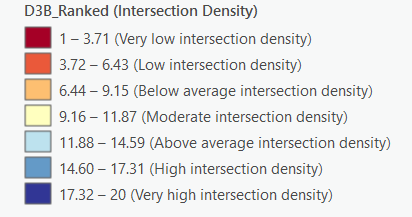
The intersection-density indicator classifies municipalities into seven categories based on the relative connectivity of their street networks. The scores represent municipal averages of the U.S. Environmental Protection Agency’s ranked intersection-density variable, D3B_Ranked, which ranges from 1 to 20. Higher scores generally indicate a greater concentration of connected intersections, smaller blocks, and more route choices for pedestrians, while lower scores generally indicate disconnected streets, larger blocks, cul-de-sacs, or dispersed rural development.
Unlike the complete National Walkability Index, intersection density measures only one component of the built environment. A municipality may have a highly connected street network while still lacking nearby destinations, mixed land uses, sidewalks, transit access, or safe street crossings.
- Very High Intersection Density (17.32–20.00): Municipalities with exceptionally connected street networks, frequent intersections, relatively small blocks, and numerous alternative routes. These conditions generally support direct pedestrian movement and make destinations easier to reach on foot.
- High Intersection Density (14.60–17.31): Municipalities with well-connected street systems and relatively frequent intersections. Traditional street grids or compact development patterns usually provide multiple route choices for pedestrians, cyclists, and local traffic.
- Above Average Intersection Density (11.88–14.59): Municipalities with generally connected street networks but some variation among neighborhoods. Older districts may contain regular grids, while newer areas may include larger blocks, curvilinear streets, or less direct connections.
- Moderate Intersection Density (9.16–11.87): Municipalities with mixed connectivity. Connected downtowns or traditional neighborhoods may coexist with suburban development characterized by longer blocks, looping streets, and limited pedestrian route options.
- Below Average Intersection Density (6.44–9.15): Municipalities where disconnected or indirect street patterns are common. Larger blocks, branching streets, cul-de-sacs, highways, and separated developments may limit direct pedestrian movement.
- Low Intersection Density (3.72–6.43): Municipalities with sparse street networks and few intersections. Development is generally low density or dispersed, and walking routes may require substantial detours because relatively few streets connect directly.
- Very Low Intersection Density (1.00–3.71): Rural communities or highly dispersed suburban areas with extremely limited street connectivity. Roads may be widely spaced, disconnected, or designed primarily for automobile access, providing few practical route choices for pedestrians.
Planning Implications
Intersection density is a widely used indicator of street connectivity and urban design. More connected street networks generally provide shorter and more direct routes between origins and destinations, increasing the number of route choices available to pedestrians and reducing the distance required to complete some trips (Cervero & Kockelman, 1997; Ewing & Cervero, 2010).
Higher-scoring municipalities generally provide:
- More direct walking routes. A greater number of interconnected streets allows pedestrians to select shorter paths rather than relying on a small number of arterial roads or indirect subdivision entrances.
- Greater route choice. Connected grids distribute movement across several streets and provide alternative routes when a particular street is uncomfortable, congested, or inaccessible.
- Improved access between nearby destinations. Schools, parks, shops, transit stops, and residential areas are more likely to be physically connected when the street network contains frequent intersections.
- Greater potential for active transportation. Research has found positive relationships between intersection density, neighborhood walkability, and objectively measured moderate physical activity (Frank et al., 2005; Frank et al., 2006).
- Reduced dependence on a limited number of major roads. A connected network can distribute local trips across multiple streets rather than funneling nearly all movement onto a few arterials.
Lower-scoring municipalities may improve pedestrian connectivity by reconnecting incomplete street networks, adding pedestrian passages between cul-de-sacs and adjacent destinations, creating smaller blocks in new development, improving crossings of major roads, and requiring new subdivisions to connect with surrounding streets.
However, increasing the number of intersections alone does not guarantee a safe or comfortable walking environment. Intersection design, traffic speed, crossing distance, sidewalks, lighting, land-use mix, destination access, and transit availability also influence whether residents can realistically walk to daily needs.
Understanding Municipal Intersection Density
Municipal intersection-density scores provide a consistent way to compare one dimension of street-network design across communities. The data supplied for this analysis use the EPA’s ranked intersection-density variable rather than a raw count of intersections. For example, the dataset assigns San Francisco a score of 17.90, Seattle 17.75, Portland 17.61, Boston 17.58, and Philadelphia 17.04, placing each within the high or very-high categories.
Several major Sun Belt cities receive above-average rather than extremely low scores. Phoenix records 14.75, Miami 16.74, Houston 14.53, Dallas 13.88, Austin 12.71, and San Antonio 12.83. These results show that broad regional labels should not replace municipality-level analysis.
Municipal averages should nevertheless be interpreted carefully. A single score can conceal substantial internal variation. A city may contain a highly connected downtown grid, moderately connected residential neighborhoods, and disconnected peripheral subdivisions. The score identifies the municipality’s overall position on the ranked scale but does not show where connectivity is strongest or weakest within its boundaries.
The American Walkability Atlas can address this limitation by pairing municipal comparisons with neighborhood- or block-group-level mapping. This allows planners and residents to identify whether low connectivity is widespread or concentrated in specific parts of a community.
Geographic Patterns in Municipal Intersection Density
Municipal intersection density exhibits recognizable regional patterns that reflect differences in historical development, subdivision design, topography, and the timing of urban growth. Older municipalities in the Northeast and Midwest frequently exhibit higher intersection densities because many neighborhoods developed before widespread automobile ownership. These communities often retain interconnected street grids, shorter block lengths, and compact urban forms that support shorter travel distances, greater route choice, and higher levels of pedestrian connectivity. In contrast, many rapidly growing postwar municipalities, particularly in the South and West, contain larger blocks, curvilinear street networks, cul-de-sac subdivisions, and lower levels of street connectivity. These regional differences reflect historical planning practices and long-term patterns of urban development (Ewing & Hamidi, 2014).
- Northeast Corridor: Older municipalities frequently contain closely spaced streets, small blocks, and interconnected grids. Cities such as Boston, Philadelphia, Baltimore, and Washington, D.C., consequently record high intersection-density scores. The compact street patterns of these municipalities were largely established before automobile-oriented subdivision design became dominant.
- Great Lakes and Upper Midwest: Traditional industrial cities commonly retain connected neighborhood grids. Chicago scores 16.39, Minneapolis 15.96, St. Paul 15.67, and Milwaukee 15.71, indicating relatively strong connectivity despite later suburban expansion.
- West Coast: Several major West Coast municipalities score highly, including San Francisco, Seattle, Portland, Long Beach, and Oakland. Their scores reflect a combination of traditional grids, compact districts, and relatively connected urban street systems, although connectivity may vary considerably at the neighborhood level.
- Sun Belt: Intersection-density results are more varied than total walkability patterns might suggest. Some central cities and older municipalities retain connected street networks, while rapidly developed outer suburbs and exurban communities often contain lower-connectivity subdivisions. In Texas, for example, University Park scores 16.47 and Cockrell Hill 16.75, while Haslet scores 4.00, Combine 3.00, and Briar 5.00.
- Suburban Growth Areas: Municipalities dominated by postwar subdivisions frequently fall into moderate, below-average, or low categories. Curvilinear roads, cul-de-sacs, superblocks, gated developments, and limited connections between adjoining subdivisions reduce the number of direct routes.
- Rural and Dispersed Communities: Very low scores are especially common where roads are widely spaced and development is scattered. In these locations, low intersection density may reflect rural settlement patterns rather than a conventional suburban street design.
Within metropolitan areas, older central cities and inner-ring communities frequently record higher connectivity than recently developed outer suburbs. This pattern is consistent with research showing that street-network design is an important component of the relationship between the built environment and travel behavior (Cervero & Kockelman, 1997; Ewing & Cervero, 2010). It also reflects the broader transition from traditional interconnected street grids to postwar subdivision patterns organized around collectors, arterials, and cul-de-sacs.
Relationship to Walkability
Intersection density contributes to walkability by determining how easily pedestrians can move through the street network. Cervero and Kockelman (1997) identify design, including street characteristics, as one of the principal dimensions connecting the built environment to travel demand. Ewing and Cervero’s (2010) meta-analysis similarly treats intersection or street connectivity as an important built-environment measure associated with travel behavior.
Frank et al. (2005) found that intersection density, residential density, and land-use mix were positively associated with objectively measured moderate physical activity. Their combined walkability index was also associated with a greater likelihood of meeting recommended physical-activity levels. Frank et al. (2006) further connected neighborhood walkability with active transportation and health-related outcomes.
The indicator should not, however, be interpreted as a complete measure of pedestrian accessibility. High intersection density creates the structural potential for walking, but that potential is realized only when the connected network also provides safe crossings, pedestrian infrastructure, reasonable traffic speeds, and useful destinations.
Overall Pattern
Municipal intersection density closely reflects the historical development of American street networks. Older communities and traditional neighborhoods commonly achieve higher scores because they were developed with smaller blocks and interconnected streets. Newer suburban and exurban communities more often receive lower scores because their streets are organized around cul-de-sacs, limited-access subdivisions, and widely spaced arterial roads.
The dataset also demonstrates that intersection density and overall walkability are related but not interchangeable. Some municipalities possess relatively connected street networks without having the density, destination diversity, transit access, or pedestrian infrastructure needed to support extensive daily walking. Accordingly, the intersection-density score is most useful when presented as a focused measure of street connectivity and interpreted alongside the other components of the National Walkability Index.
Downtown Chicago: Chicago’s downtown has extremely tight block spacing (some major streets half-block apart) which likely corresponds to very high intersection density.
Downtown / Central Neighborhoods in Older Cities: Many block groups in very dense, gridded “city-center” neighborhoods (e.g., parts of Manhattan, Washington DC, Boston) will score very high in intersection density. The NWI map itself shows highest walkability block groups clustering in dense urban cores.
High Intersection Density
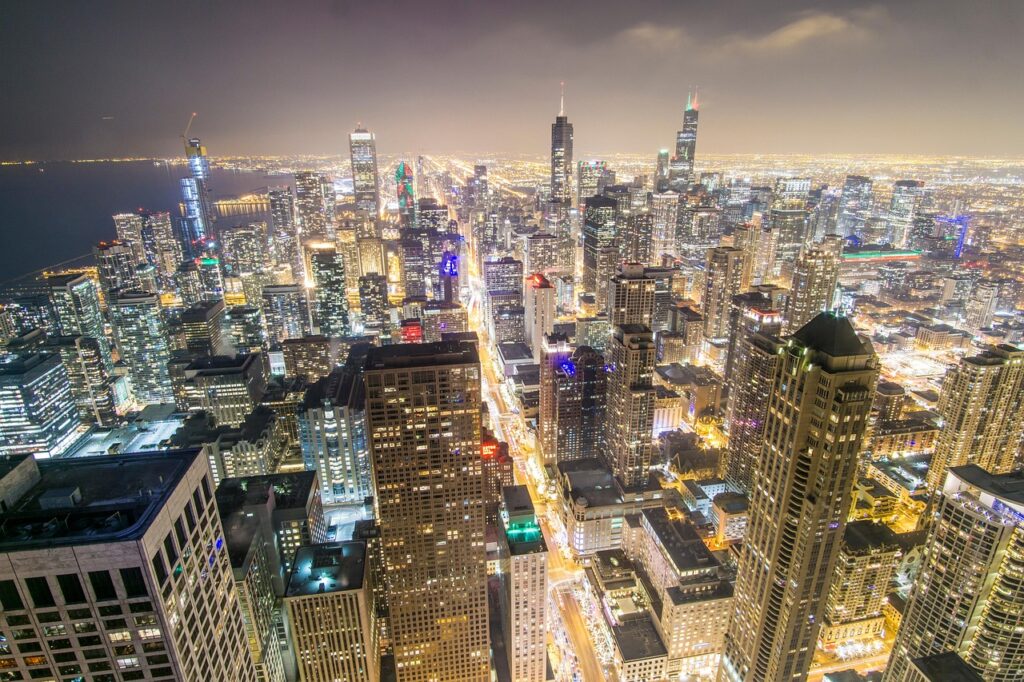
The Chicago Loop has a Intersection Density score of 19 out of 20. City blocks are usually no more than 500 ft.

The North End of Boston illustrated above has a Intersection Density of 20 out of 20
Medium Intersection Density
Historic Town Centers / Suburban Town Centers: In the NWI methodology guide, they use an example: a “city center / suburban town center” block group that scores relatively high on intersection density.
Older Suburban Neighborhoods: Suburbs with moderate grid / street connectivity — not as tight as downtown but more connected than sprawling suburbs — would likely fall into medium quantiles of intersection density.
Low Intersection Density
Rural or Semi-Rural Block Groups: Very low walkability block groups in the NWI (scores ~1–5.75) often correspond to low intersection density, because they’re more sprawling and have fewer intersections per area.
Suburban / Exurban Development: Areas with hierarchical street networks, cul-de-sacs, and fewer cross-streets (tree-like street networks) will have low intersection densities. This is common in more car-oriented suburbs.
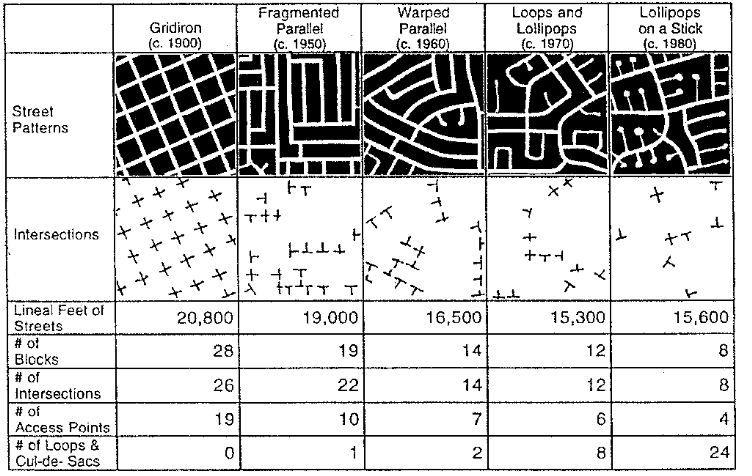
Graph above from Michael Southworth, which shows the devolution of intersections over the decades, particularly in the United States. The illustration below demonstrates how street network design has evolved over time. Earlier neighborhoods typically contained interconnected grid street systems with numerous intersections, while many postwar suburban developments adopted curvilinear streets and cul-de-sacs that reduced overall connectivity.
Why It Matters
Intersection density is one of the most widely used measures of street network connectivity because it directly influences how easily people can travel through a neighborhood. A greater number of connected intersections typically provides shorter travel distances, more route choices, and improved access to destinations. Numerous planning and transportation studies have identified intersection density as a strong predictor of walking for transportation and overall urban connectivity (Ewing & Hamidi, 2014; U.S. Environmental Protection Agency, 2019).
Planning Applications
Intersection density maps can support:
- Comprehensive planning
- Active transportation planning
- Bicycle and pedestrian planning
- Metropolitan transportation planning
- Growth management
- Land use analysis
- Comparative metropolitan research
- Infrastructure investment prioritization
Other Planning Implications
Although intersection density alone does not determine walkability, it is one of the strongest indicators of street network connectivity. Municipalities with higher concentrations of connected streets generally provide more direct walking routes, support walking, bicycling, and transit accessibility, and reduce travel distances. Conversely, municipalities dominated by disconnected suburban street patterns often require longer trips and encourage automobile dependence. These patterns can inform transportation planning, comprehensive planning, infrastructure investment, and future growth strategies (Ewing & Hamidi, 2014).
Limitations
Intersection density should not be interpreted as a complete measure of walkability. It evaluates street network connectivity but does not account for sidewalk quality, pedestrian crossings, traffic speed, land use, safety, shade, accessibility, or pedestrian comfort. Consequently, areas with relatively high intersection density may still present barriers to walking, while some lower-density communities may provide high-quality pedestrian infrastructure (Atlanta Regional Commission, 2020).
References
- Atlanta Regional Commission. (2020). Town Center CID Sidewalk Network and Walkability Assessment (p. 44) [Technical Report]. Atlanta Regional Commission. https://cdn.atlantaregional.org/wp-content/uploads/tccid-sidewalk-network-walkability-assessment.pdf
- Cervero, R., & Kockelman, K. (1997). Travel demand and the 3Ds: Density, diversity, and design. Transportation Research Part D: Transport and Environment, 2(3), 199–219. https://doi.org/10.1016/S1361-9209(97)00009-6
- Ewing, R., & Cervero, R. (2010). Travel and the built environment: A meta-analysis. Journal of the American Planning Association, 76(3), 265–294. https://doi.org/10.1080/01944361003766766
- Ewing, R., & Hamidi, S. (2014). Measuring Urban Sprawl and Validating Sprawl Measures (p. 114) [Research Report]. National Cancer Institute, National Institutes of Health. https://gis.cancer.gov/tools/urban-sprawl/sprawl-report-short.pdf
- Frank, L. D., Sallis, J. F., Conway, T. L., Chapman, J. E., Saelens, B. E., & Bachman, W. (2006). Many pathways from land use to health: Associations between neighborhood walkability and active transportation, body mass index, and air quality. Journal of the American Planning Association, 72(1), 75–87. https://doi.org/10.1080/01944360608976725
- Frank, L. D., Schmid, T. L., Sallis, J. F., Chapman, J., & Saelens, B. E. (2005). Linking objectively measured physical activity with objectively measured urban form. American Journal of Preventive Medicine, 28(2), 117–125. https://doi.org/10.1016/j.amepre.2004.11.001
- Southworth, M. (2005). Designing the Walkable City. Journal of Urban Planning and Development, 131 (4), 246–257. https://doi.org/10.1061/(ASCE)0733-9488(2005)131:4(246)
- U.S. Department of Housing and Urban Development, Office of Policy Development and Research. (n.d.). Pedestrian connectivity: Healthy Communities Assessment Tool.
- U.S. Environmental Protection Agency. (2019). EnviroAtlas – New York, NY – Estimated Intersection Density of Walkable Roads [Geospatial Data]. Data.gov. https://catalog.data.gov/dataset/enviroatlas-new-york-ny-estimated-intersection-density-of-walkable-roads
- U.S. Environmental Protection Agency. (2021). National Walkability Index: Methodology and User Guide.